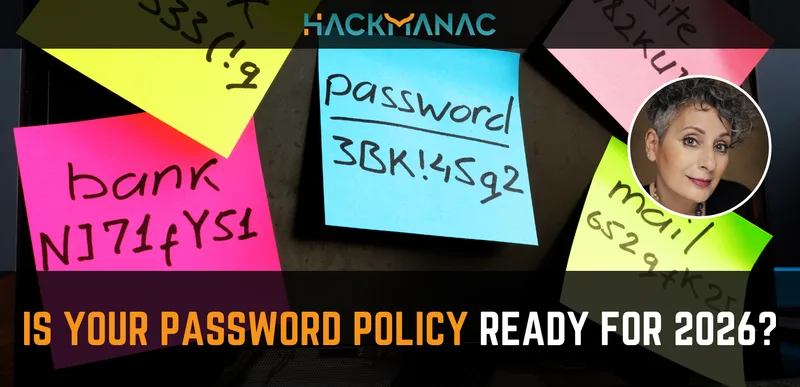
In recent weeks, password security has returned to the spotlight because of series of severe incidents that reveal how fragile our authentication model still is as we approach 2026.
Starting with the Louvre, where an overly simplistic password (“Louvre”) in the surveillance system facilitated the incredible theft of $102 million worth of jewellery from one of the world's most iconic museums.
Then the far more disturbing case of an Indian hospital, whose CCTV cameras were compromised due to a default credential (“admin123”), enabling hackers to steal footage of women undergoing gynaecological examinations and sell it to an international porn fetish network.
And most recently, a massive hacking operation in South Korea came to light, with over 120,000 home and business cameras breached simply by exploiting weak or default passwords. This resulted in the production of thousands of sexually exploitative videos, which were then sold on underground platforms.
Different contexts, same core issue: when authentication fails, not only IT systems break, but also people, privacy, trust and safety can be exposed.
Weak Passwords Are No Longer Only a “Tech Problem”
Recent incidents are alarming, not only because of their consequences, but also for what they reveal about how deeply technology is embedded in our personal and professional lives. Regrettably, this is happening with users generally lacking even a basic understanding of the potential risks associated with cybersecurity.
We now live in a world where countless devices rely on passwords as their first (and often only) line of defense:
- building control systems
- cameras and CCTV
- medical devices
- smart home infrastructure
- industrial and operational systems
Although these technologies have now become commonplace, they are generally manufactured, sold, and deployed with default credentials that often remain unchanged for years.
This cannot be framed as a user problem any longer. Users are neither forced to change default passwords nor adequately trained to understand security risks and how to mitigate them.
This is a systemic failure in configuration practices and in security by design.
The Password Crisis Is Global
Comparitech’s 2025 list of the most common passwords is deeply worrying.
The top 10 most used are:
- 123456
- 12345678
- 123456789
- admin
- 1234
- Aa123456
- 12345
- password
- 123
- 1234567890
Attackers can guess those passwords in seconds.
However, the issue is not that people are careless or uninformed. The real problem is that digital accounts have multiplied and passwords are everywhere with an authentication model still forcing users to do something they were never designed to handle and inevitably leading to failure.
The complexity, volume, and cognitive load of password management are fundamentally incompatible with today’s threat landscape.
What Does a Real Strong Password Actually Mean in 2026?
Recent NIST-aligned recommendations are reshaping how users and organizations should think about password policy, and, surprisingly, special characters are no longer considered mandatory.
According to NIST, modern strong authentication requires:
- Long passphrases instead of complex strings: 14+ characters, easy to remember, hard to predict.
- No standalone dictionary words or personal data: names, birthdays, locations are too predictable.
- Automatic blocking of passwords found in breaches: NIST explicitly recommends rejecting any credential already exposed.
- No mandatory special characters: complexity rules lead to predictable substitutions (like adding “!” or “?” at the end of the password) and result in poor usability.
- Phishing-resistant MFA (Multi-Factor Authentication) as the standard: with FIDO2/WebAuthn security keys, passkeys and device-bound cryptographic authentication. SMS OTP is no longer sufficient for high-risk environments.
- Zero tolerance for default or shared passwords: IP cameras, medical devices, IoT sensors, HVAC systems, printers — all must be individually secured.
- Behavioural detection around authentication events: impossible travel, anomalous device fingerprints and brute-force attempts should be automatically flagged and blocked.
We Keep Blaming Users for a System That Fails by Design
If even the world’s most famous museum, a healthcare facility, and over 120,000 household and business devices can all be compromised for the same reason, the lesson is clear: humans are not the (only) weak link, it is the password system instead.
The current model, based on endless complex rules, overly complicated credentials, frequent rotations, and inevitable mismanagement, is outdated.
Modern authentication systems must shift responsibility away from human memory and towards secure, user-friendly technology.
On the other hand, users must be trained on realistic practices, such as leveraging long passphrases, password managers, MFA, secure devices with biometrics or passkeys, and avoiding reuse, rather than being taught how to create complicated passwords.
Conclusion
Weak passwords are no longer a funny joke anymore, they are a predictable failure mode.
And predictability is exactly what attackers count on.
Until organizations redesign authentication processes to prioritise usability, cryptographic assurance, and passwordless methods, these incidents will continue to have consequences that increasingly affect not only assets, but people themselves.
The time to act is now, before the next breach hits the headline.
Stay Cyber Safe!